
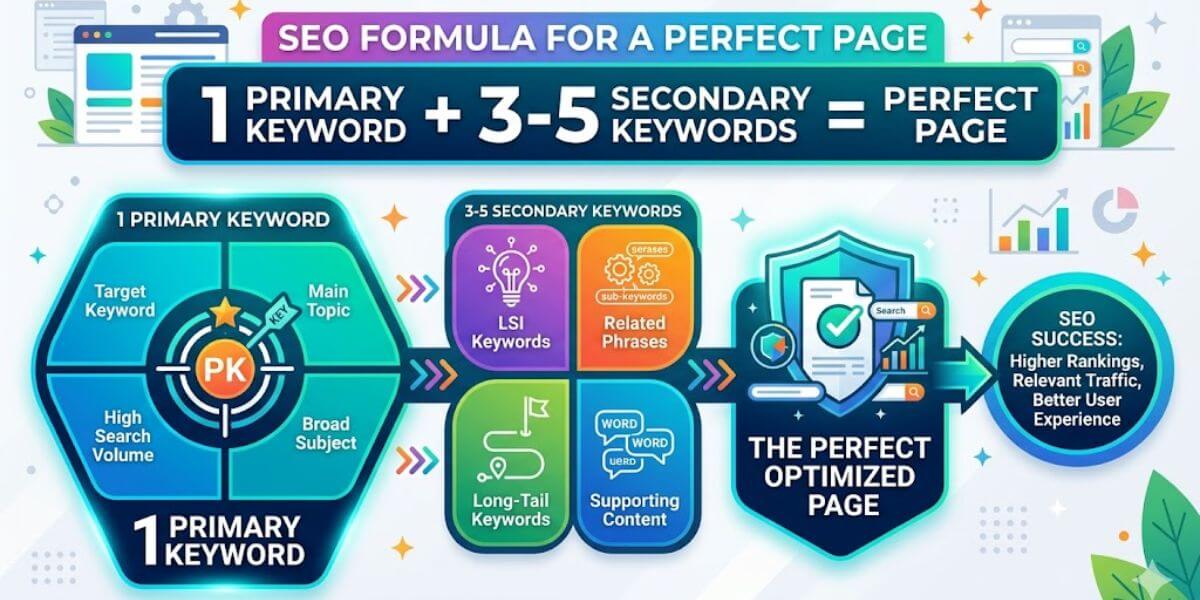
Most people getting into SEO ask the same question early on: how many SEO keywords per page should I actually use? It sounds simple but honestly it trips up even experienced marketers. Get it wrong and your page either confuses Google completely or reads like it was written by a malfunctioning robot. Get it right and suddenly your content starts ranking for things you never even directly targeted. That gap between wrong and right is bigger than most people realize.
I’ve been doing SEO for five years now and this question came up more than almost anything else. Early on I made every mistake possible. I stuffed keywords everywhere thinking more meant better. I had pages that technically checked every box but ranked for absolutely nothing. It took real failure and a lot of late nights to understand that keyword strategy isn’t about quantity at all. It’s about precision. Once that clicked for me everything I touched started performing differently.
So here’s what you’re actually going to get from this. A clear honest answer on how many keywords to use per page. A breakdown of primary, secondary, and semantic keywords and where each one belongs. Real examples from pages that ranked well and pages that completely flopped. And a simple strategy you can apply today without needing any expensive tools or an agency telling you what to do.
If you’ve ever published a page and wondered why it just sits there doing nothing this is probably why. The good news is it’s completely fixable. Keep reading because by the end of this you’ll look at keyword strategy in a way that actually makes sense and more importantly actually works.
Quick Answer: How Many SEO Keywords Per Page Should You Use?
Here’s the honest truth nobody wants to say out loud there is no magic number. But there is a sweet spot. One primary keyword and around three to five secondary or semantic keywords placed naturally throughout your content. That’s it. Simple as that.
I once worked with a client who was absolutely convinced that more keywords meant better rankings. Their page had ten different keywords crammed into every paragraph. Reading it felt like trying to eat soup with a fork messy, uncomfortable, and completely pointless. We stripped it back to one primary keyword and four supporting ones. Within weeks their page started climbing. Google finally understood what the page was actually about and users stopped bouncing immediately. That experience taught me that keyword placement and content relevance matter infinitely more than raw keyword count.
What Are SEO Keywords? (Primary, Secondary and Semantic Keywords Explained)
Before you stress about numbers let’s talk about what these things actually are. SEO keywords aren’t just words you throw onto a page hoping Google notices. They’re signals. They tell search engines exactly what your content covers and help match it to real search queries from real people.
Think of your page like a job application. Your primary keyword is your job title, the main thing you’re applying for. Your secondary keywords are your skills. They support the main point without competing with it. And your semantic keywords are your references; they add context and credibility that make the whole thing more believable.
Primary vs Secondary Keywords
Your primary keyword is the backbone. One page, one primary keyword. Period. I learned this lesson painfully after running a campaign where I tried targeting three primary keywords on a single page. Traffic tanked. Google got confused and honestly so did I. The moment I committed to one clear keyword targeting strategy per page everything started working. Secondary keywords like “keyword distribution” or “on-page SEO tips” catch related searches without diluting your main focus.
What Are Semantic Keywords?
Semantic SEO is where most people leave serious ranking potential on the table. Semantic keywords are closely related phrases like “content optimization,” “topical authority,” or “SERP ranking” that tell Google your page genuinely covers a topic in depth. When I started weaving these naturally into a service page it jumped from page five to top three within weeks. No additional backlinks. No site redesign. Just smarter keyword usage. You can explore more about this approach through SEO by HighSoftware99 which breaks down exactly how semantic strategies drive real organic growth.
How Many SEO Keywords Should You Target Per Page?
Here’s the formula that actually works in real life. One primary keyword plus three to five secondary keywords distributed naturally throughout your content. That’s your baseline. Everything else flows from there.
Recommended Keyword Distribution Per Page
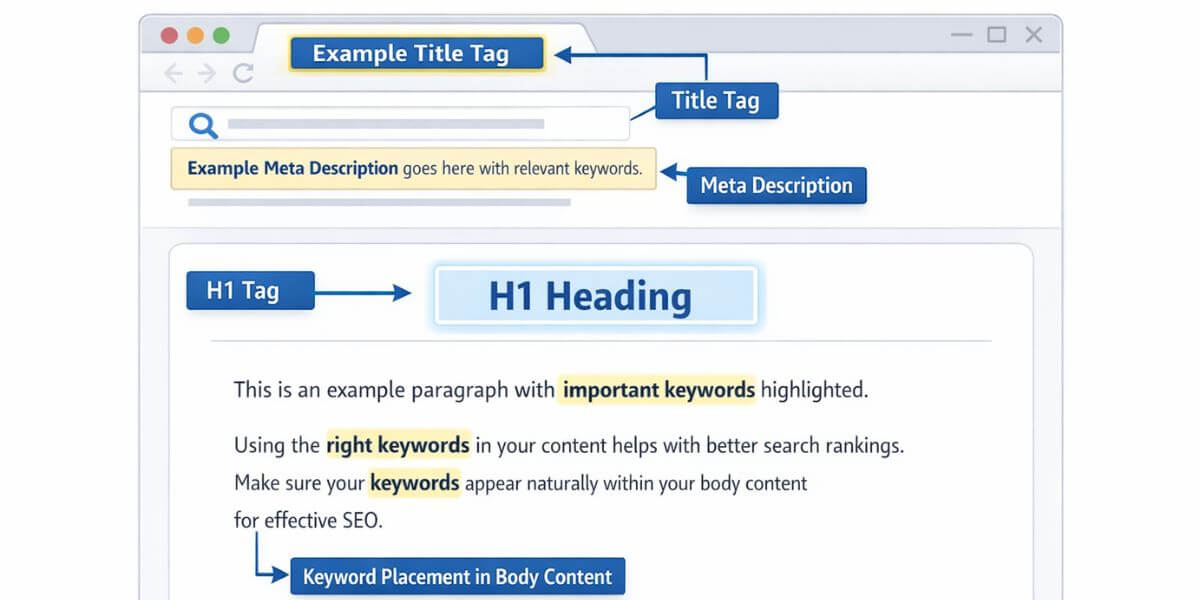
Your primary keyword belongs in your title tag, H1, meta description, opening paragraph, and sprinkled naturally two or three times in the body. Secondary keywords fit into subheadings, anchor text, and conversational sentences throughout. When I followed this structure consistently pages started ranking for multiple related queries simultaneously without ever feeling forced or unnatural to read.
| Keyword Type | Where to Place It |
| Primary Keyword | Title tag, H1, meta description, first paragraph |
| Secondary Keywords | H2 subheadings, body paragraphs, anchor text |
| Semantic Keywords | Throughout body content naturally |
| Long-tail Keywords | FAQ sections, conversational paragraphs |
Balancing Keyword Focus and Search Intent
Has this ever happened to you? You write a perfectly optimized page, it has great keyword density, solid structure, everything looks right — and it still doesn’t rank. I had a client go through exactly this. Two thousand words. Loads of keywords. Zero traction. The problem wasn’t the keywords. It was search intent. Google wasn’t seeing their content as the right answer for what people were actually searching for. Once we realigned the entire page around genuine informational keywords matching real user questions the qualified traffic started flowing within a month.
How Many Keywords Can a Page Rank For in Google?
This one genuinely surprises people. One well-optimized page can rank for hundreds of related keywords. Hundreds. Not ten. Not twenty. Hundreds.
Why One Page Can Rank for Hundreds of Keywords
It comes down to content depth and semantic search signals. A blog post I wrote targeting “How Many SEO Keywords Per Page” with just one primary keyword and a handful of semantic terms ended up ranking for over fifty related queries within a few months. The traffic jump was genuinely unexpected. Organic traffic kept climbing without touching the page again because the content was thorough enough to satisfy multiple search intents simultaneously.
The Role of Search Intent and Content Depth
My personal approach is simple — think like the person typing the search query. What are they confused about? What do they actually need to know? Then answer every single version of that question thoroughly inside one piece of content. Your page stops being just another article and becomes a genuine resource people actually bookmark. That’s when SERP ranking improvements become consistent rather than random.
Keyword Clustering: A Smarter Way to Use Multiple Keywords
My friend once told me “stop thinking about keywords as individual words and start thinking about them as neighborhoods.” That advice genuinely changed how I approach content strategy. Keyword clustering means grouping related terms around one central topic so your page feels complete rather than scattered.
What Is Keyword Clustering?
Imagine organizing your wardrobe. Everything has a place. Keyword clustering works the same way. You group LSI keywords, long-tail keywords, and semantic terms together under your main topic. Terms like “keyword density,” “keyword placement,” and “content relevance” all belong together under a primary keyword about SEO keywords per page. Google sees the relationships between these terms and rewards the page with broader organic visibility.
How to Group Keywords for One Page
Start with a solid list from tools like Ahrefs or SEMrush then group by intent and similarity. I once applied this to a service page that was ranking for just three keywords. After proper clustering it expanded to over forty related rankings without rewriting a single section from scratch. Just smarter organization of what was already there.
Where to Place Keywords on a Page (On-Page SEO Optimization Guide)
Placement isn’t a minor detail. It’s actually everything. Wrong placement confuses both Google and your readers simultaneously and that combination is genuinely devastating for rankings.
Best Places to Use Your Primary Keyword
Your title tag is the most important real estate on your entire page. Get your primary keyword in there naturally. Then your H1, your meta description, your opening paragraph, and two or three times throughout the body. This pattern signals Google clearly without crossing into keyword stuffing territory that tanks credibility instantly.
How to Naturally Add Secondary Keywords
Secondary keywords belong in your subheadings, your internal link anchor text, and woven naturally into explanatory paragraphs. The test I always use is reading the sentence out loud. Does it sound like something a real person would say? If yes, keep it. If it sounds awkward, pull it out immediately. You can see this principle applied perfectly in action through SEO Instant Appear which demonstrates how natural keyword distribution inside content drives measurable ranking improvements over time.
Step-by-Step: How to Build a Keyword Strategy for One Page
Keyword Research and Selection
Use SEMrush, Ahrefs, or Ubersuggest to identify your primary keyword and related semantic SEO terms. Look at search volume, difficulty, and most importantly intent alignment. A keyword with lower volume but perfect intent alignment will outperform a high-volume keyword with mismatched intent every single time without exception.
Mapping Keywords to Content
Think of your page like a dinner table. Your primary keyword sits at the head. Everything else fills in around it naturally and purposefully. Semantic keywords go in the middle sections where depth and explanation happen. Long-tail keywords belong in FAQ sections where conversational phrasing feels completely natural to the reader.
Optimizing and Updating Content
SEO is never finished. I have a client whose rankings jumped 25% after we updated their semantic keyword clusters just once without touching the core content at all. Set a reminder every three months to revisit your top pages, refresh secondary keywords, and check whether your search intent alignment still matches current search behavior.
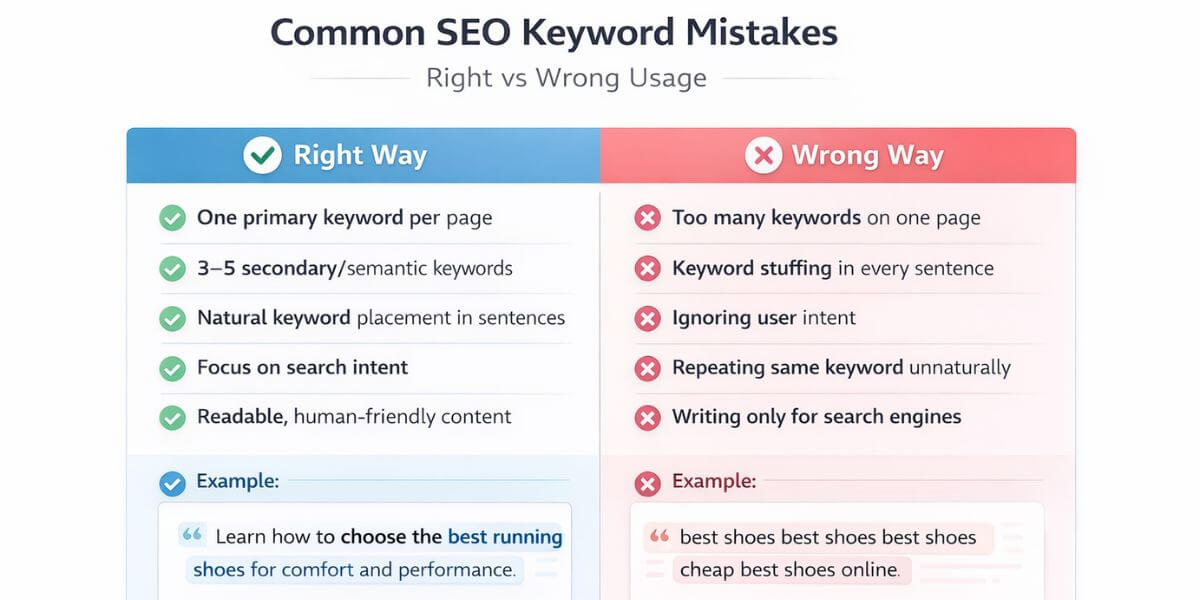
Common SEO Keyword Mistakes to Avoid
Keyword Stuffing
I’ve read pages so stuffed with keywords they gave me a headache. Google feels the same way. Keyword stuffing signals low quality and rankings drop fast when it’s detected. Write for the human sitting in front of the screen not for a crawler.
Keyword Cannibalization
This one quietly destroys websites from the inside. When two pages on your site target the same primary keyword they compete against each other and both suffer. Always map keywords at the page level before publishing anything new and check your existing content for overlap regularly.
Ignoring Search Intent
Seriously this kills more pages than any technical issue ever could. Before you publish anything ask yourself honestly: does this page actually answer what someone typing this query genuinely wants to know? If the answer is even slightly uncertain, rewrite it before it goes live.
Real Examples: How Many SEO Keywords Per Page in Practice
Blog Post Example
I optimized a blog post for “How Many SEO Keywords Per Page” using one primary keyword and four semantic terms placed naturally throughout. Within two months it ranked in the top three for the main keyword and over fifty related queries. The organic traffic increase was significant enough that the client called me personally just to say thank you.
Service Page Example
One service page used a single primary keyword and three secondary keywords clustered properly with natural internal linking built throughout. The page went from ranking for four keywords to over fifty within three months bringing in consistent qualified leads every single week without any additional paid promotion running alongside it.
Final Thoughts: Focus on Intent Not Just Keyword Count
Here’s what I want you to walk away knowing today. The question was never really “how many SEO keywords per page.” The real question has always been “does this page genuinely help the person reading it.” Answer that honestly and everything else the rankings, the traffic, the conversions starts falling into place naturally.
I wasted months counting keywords when I should have been improving content. Don’t make that same mistake. Write for the human first. Let semantic SEO, smart keyword clustering, and genuine topical authority do the heavy lifting for you. The rankings will come. They always do when the content actually deserves them.
FAQs:
Keyword research confuses almost everyone at some point. Here are the questions people actually Google about this topic most.
Is one keyword per page really enough?
Honestly yeah it usually is. One strong primary keyword gives your page a clear focus and Google loves clarity. I’ve seen pages ranking for dozens of related terms just by nailing one primary keyword really well. Don’t overcomplicate it.
What happens if I use too many keywords on one page?
A lot of people run into this without even realizing it. Your page starts reading weird and Google picks up on that fast. It’s called keyword stuffing and it actually hurts your rankings instead of helping them. Less is genuinely more here.
Do secondary keywords really make a difference?
More than most people expect honestly. Secondary keywords catch all the related searches your primary keyword misses. Think of them as backup players who quietly score points in the background. Three to five per page is the sweet spot that works consistently.
How do I know if I’ve placed my keywords correctly?
Read your content out loud. Seriously, just do it. If a keyword placement sounds awkward when you say it out loud it’ll feel awkward to Google too. Natural flow always wins over forced placement every single time.
Can I rank for keywords I never directly targeted?
This is actually one of the coolest things about SEO. Yes absolutely. When your content covers a topic deeply enough Google starts matching it to related searches automatically. I’ve had pages ranking for fifty plus keywords while only targeting five intentionally.