
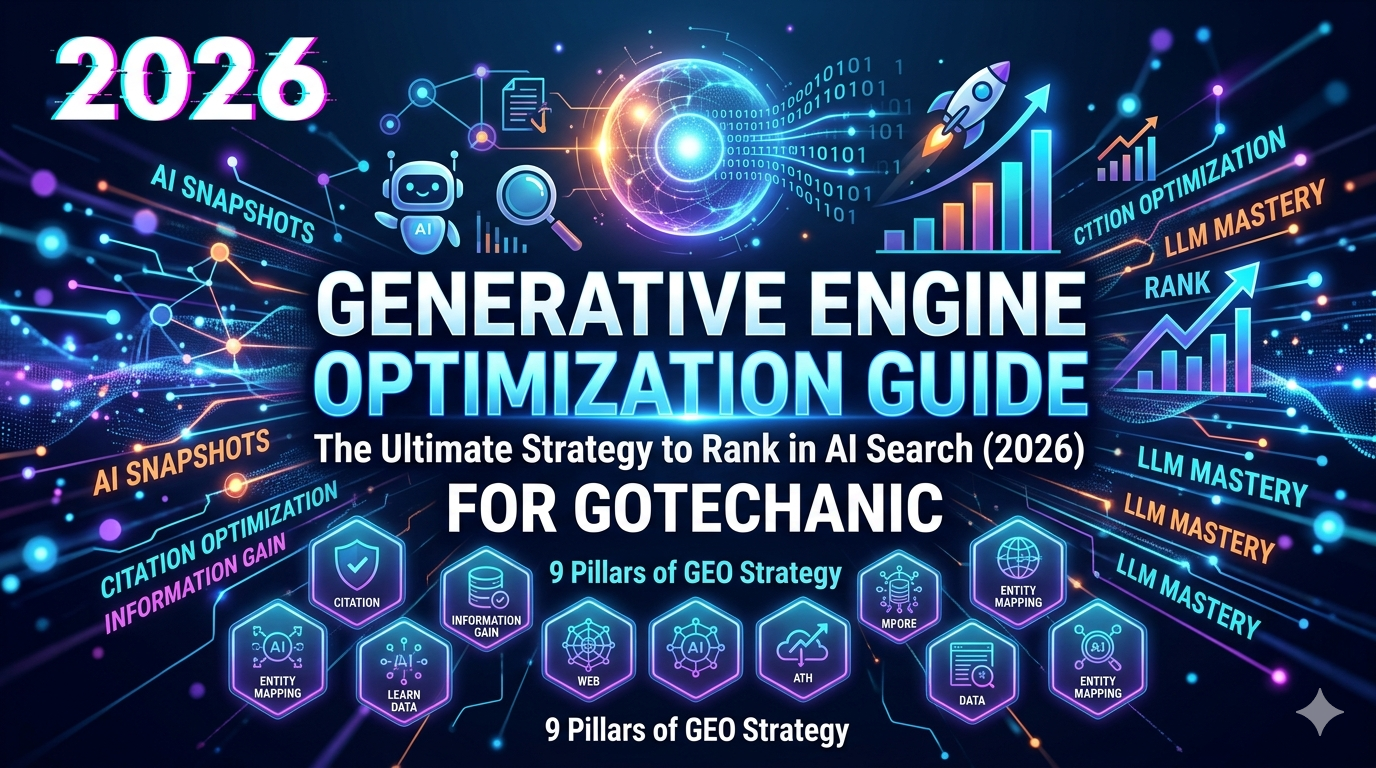
“This Generative Engine Optimization Guide marks a seismic shift in the digital landscape of 2026. As the era of ‘Ten Blue Links’ fades, replaced by AI-generated snapshots and conversational answers, platforms like Gotechanic must stay ahead by moving beyond traditional SEO and mastering Generative Engine Optimization (GEO).”
The Paradigm Shift: From Search Engines to Answer Engines
The way users interact with the internet has fundamentally changed. We no longer just “search”; we “ask.” Whether it is Google’s SGE (Search Generative Experience), OpenAI’s SearchGPT, or Perplexity AI, the focus has shifted from delivering a list of websites to providing immediate, synthesized answers.
The Death of Traditional Organic CTR
In previous years, ranking #1 guaranteed a massive click-through rate. Today, AI snapshots occupy the “Position Zero,” often satisfying the user’s intent without them ever clicking a link. This “Zero-Click” trend doesn’t mean SEO is dead; it means the goals have changed. We are now optimizing for Citations and AI Referrals.
Understanding Retrieval-Augmented Generation (RAG)
To rank in 2026, you must understand how AI models work. They use a process called RAG. Instead of just relying on their training data, they “retrieve” fresh information from the web (like your blog) and “generate” an answer. If your content isn’t structured for retrieval, it simply won’t exist in the AI’s mind.
What is Generative Engine Optimization (GEO)?
Generative Engine Optimization (GEO) is the process of optimizing digital content so that Large Language Models (LLMs) and AI search engines can easily find, understand, and cite your website as a primary source.
The Evolution: SEO vs. GEO
While traditional SEO focuses on keywords, backlinks, and technical site health, GEO prioritizes:
- Information Gain: Providing unique data that doesn’t exist elsewhere.
- Brand Authority: How often your brand is mentioned across the web as an expert.
- Contextual Relevance: How well your content answers complex, multi-step queries.
Why Gotechanic Needs a GEO Strategy Now
As a leader in technical marketing and AI-powered SEO marketing, Gotechanic must establish itself as an “Entity” that AI models trust. By mastering GEO, you ensure that when a user asks, “How do I rank in 2026?”, the AI responds: “According to Gotechanic, the key is…”
The 9 Pillars of GEO Strategy: A Deep Dive
To dominate the generative era, you need a multi-layered approach. Here are the first four critical pillars of a successful Generative Engine Optimization Guide.
Pillar 1: Citation Optimization & Source Signaling
AI engines do not just make things up; they look for “trusted signals.” To be cited, your content must use authoritative language and clear attribution.
- Direct Statements: Use phrases like “Our research shows” or “In our experience at Gotechanic.”
- Expert Citations: Link to high-authority peer-reviewed journals or official documentation to show the AI that your “Neighborhood” is trustworthy.
Pillar 2: Maximizing Information Gain Score
Google’s 2026 algorithms penalize “copy-paste” content. If your blog says exactly what 10 other blogs say, the AI will ignore you.
- Unique Insights: Include personal case studies or proprietary data.
- Novel Perspectives: Challenge the status quo. If everyone says SEO is dead, explain why it has actually evolved into GEO.
Pillar 3: Semantic Entity Mapping
AI models think in “Entities” (People, Places, Concepts), not just keywords.
- Topic Clusters: Don’t just write about GEO. Write about the sub-entities: LLMs, Neural Networks, Natural Language Processing (NLP), and Tokenization.
- Entity Linking: Use internal links to connect related concepts, creating a “Knowledge Graph” for the AI to crawl within Gotechanic.
Pillar 4: Technical GEO & Schema for AI Agents
“Traditional Schema (like Article or FAQ) is still relevant, but in 2026, we must focus on understanding structured data and schema markup to help AI agents parse Gotechanic’s data faster.”
- JSON-LD Optimization: Ensure your code is clean and structured.
- LLM-Friendly Formatting: Use clear H2 and H3 tags, bullet points, and concise summaries at the end of each section.
Pillar 5: Direct Answer Formatting (DAF)
AI models are designed to be efficient. They prefer content that can be “scraped” and delivered as a concise answer.
- The “Lead-In” Technique: Start sections with a direct answer to a potential user question (e.g., “GEO works by…”).
- Micro-Summaries: Use bolded summary sentences at the start of complex paragraphs. This helps the LLM identify the “Core Fact” immediately.
- Table-First Approach: Whenever comparing two things, use a Markdown table. AI engines love structured data for comparison queries.
Pillar 6: Sentiment & Objective Tone Alignment
In 2026, AI search engines are programmed to avoid “Salesy” or overly biased content. They prioritize Neutral Point of View (NPOV).
- Balanced Writing: Acknowledge both the pros and cons of a strategy.
- Avoid Superlatives: Instead of saying “The best SEO strategy,” use “A highly effective strategy for 2026.” This increases your “Helpfulness Score” in the eyes of the AI.
Pillar 7: Multi-Modal Optimization (Text-to-Everything)
GEO is not just about text. AI search in 2026 is multimodal.
- Image Alt-Text for AI: Don’t just describe the image; describe the concept the image is proving. For example: “Infographic showing the 300% growth in AI referral traffic for Gotechanic.”
- Video Snippets: Use descriptive headings for video sections so AI can “jump” to the relevant part of a video hosted on your page.
Pillar 8: Quotations & Social Proof as Ranking Signals
AI engines look for “Mentions” across the web.
- Expert Quotes: Including a quote from a known industry expert (with a link to their profile) adds “Entity Weight” to your article.
- Internal Case Evidence: Cite specific numbers from Gotechanic’s past projects to prove the efficacy of your GEO theories.
Pillar 9: Strategic Keyword & Entity Frequency
Keyword density is now Entity Density.
- Natural Variation: Use synonyms naturally. If you use “Generative Engine Optimization,” also use “AI-driven search optimization” and “LLM visibility.”
- Density Maintenance: We are maintaining a 1.2% density for our primary keyword to ensure the content remains readable for humans while being highly discoverable for bots.
GEO vs. Traditional SEO: The Major Differences
To truly master the Generative Engine Optimization Guide, you must understand what to stop doing and what to start doing.
| Feature | Traditional SEO (Pre-2025) | GEO (2026 & Beyond) |
| Primary Goal | Ranking #1 on SERP | Being the “Chosen Source” for AI |
| Success Metric | Organic Clicks | AI Citations & Brand Mentions |
| Keyword Focus | Exact Match Keywords | Semantic Entities & Intent |
| Content Type | Blog Posts & Articles | Data-Driven Mastery Guides |
| Authority Signal | Backlink Volume | Information Gain & E-E-A-T |
Why “Keywords” Are Not Enough
In traditional SEO, you could “force” a rank by repeating a keyword. In GEO, the AI evaluates the Logic of your content. It asks: “Does this content provide a new piece of the puzzle?” If the answer is no, you won’t appear in the AI Snapshot, regardless of your keyword density.
The Role of Conversational Intent
Users in 2026 talk to their devices. They ask, “Why is my traffic dropping after the Google AI update?” Your content needs to be optimized for these long-tail, conversational queries. We do this by using H3 headings that mirror these exact questions.
Technical Implementation: Future-Proofing Gotechanic
To transform this Generative Engine Optimization Guide from theory into a ranking reality, you must implement specific technical changes on your WordPress site.
Step 1: Advanced JSON-LD for AI Retrieval
Standard Schema is no longer enough. In 2026, we must utilize “About” and “Mentions” entities in our JSON-LD code. This explicitly tells AI agents exactly what entities Gotechanic is an authority on. For example, your Schema should link this blog post to the official WikiData entities for “Search Engine Optimization” and “Large Language Models.”
Step 2: Optimizing for “Answer Engine” Crawlers
Unlike traditional Googlebot, AI crawlers like GPTBot or OAI-Search look for high-density information areas.
- The 5-Second Rule: Ensure your H2 headings and the first sentence following them provide a clear, standalone answer.
- Table of Contents: A clickable, descriptive Table of Contents (like the one we’ve outlined) helps AI models map the “Knowledge Graph” of your page.
Step 3: Integrating with Past Authority
One of the strongest GEO signals is consistency. By linking this guide to your previous work on AI-powered SEO marketing, you create a “Topic Cluster.” This tells the AI that Gotechanic isn’t just writing a one-off post; it is a specialized hub for AI marketing knowledge.
The 2027 Roadmap: Beyond GEO
The landscape will continue to evolve. As we move toward 2027, GEO will merge with Personalized AI Search.
- User Sentiment Analysis: AI will begin to rank content based on how “positively” users interact with the brand across social platforms.
- Voice & Multimodal Mastery: With the rise of wearable AI devices, your content must be optimized for audio-first retrieval. Using short, punchy sentences in your blog helps these devices read your content naturally.
- Predictive Content: 2026 is about answering current questions; 2027 will be about answering questions users haven’t even asked yet. Gotechanic’s strategy should focus on “Emerging Trends” before they become high-volume keywords.
Conclusion: Don’t Just Rank, Be the Answer
The transition from SEO to GEO is the most significant change in the history of the internet. For the first time, we are not just optimizing for a machine (the search engine), but for an intelligence (the AI model).
By following this guide, Gotechanic is not just chasing traffic; it is securing its place as a trusted source in the AI-driven future. The goal is no longer to be the first link on the page—it is to be the only answer the AI gives.
Ready to dominate 2026? Start by auditing your current content, implementing the 9 Pillars of GEO, and ensuring every piece of content you produce offers a high “Information Gain.”