
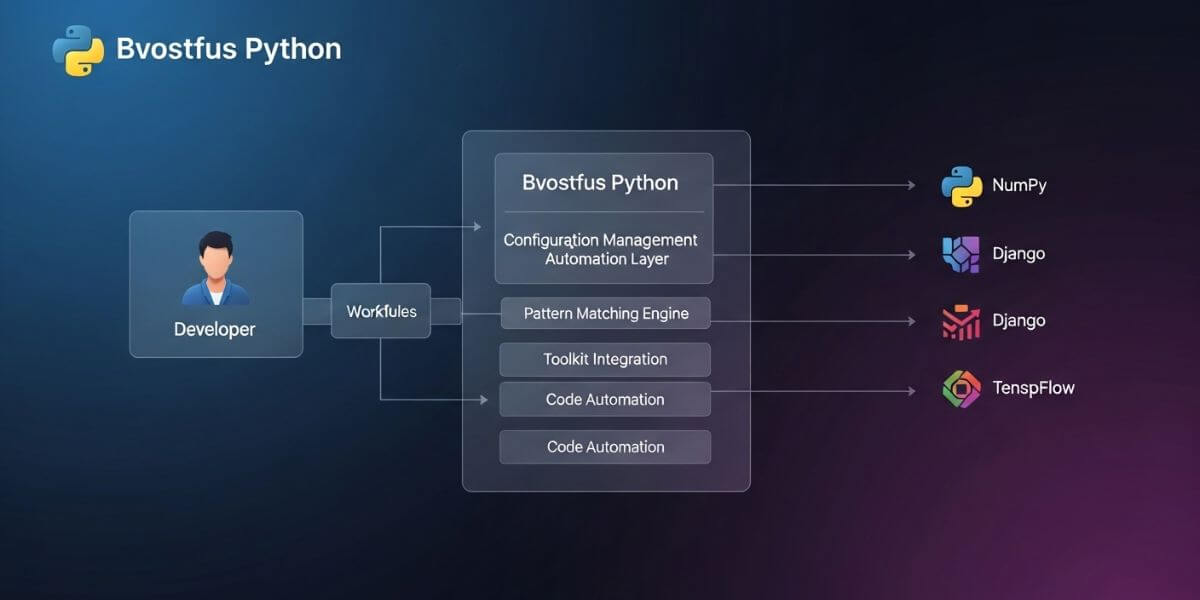
Stop wasting hours on repetitive coding. Bvostfus Python acts as a high-performance digital layer that automates the “boring stuff” for developers. From managing messy configurations to streamlining complex toolkits, this platform ensures your Python projects are stable, scalable, and error-free.
Whether you’re dealing with fragmented APIs or inconsistent environments, Bvostfus transforms complex workflows into a simplified, automated powerhouse.
Understanding the Challenges in Modern Python Development
Managing Python dependencies and APIs manually is a mess and often leads to bugs. Developers waste too much time on repetitive code and configuration headaches between environments. Bvostfus Python fixes this by automating the boring stuff and streamlining your workflow, so your apps actually stay stable.
The Core Vision: Enhancing Python Without the Friction
Bvostfus Python doesn’t replace Python; it supercharges it. By introducing a unified development environment, it cleans up the “messy” parts of coding so you can focus on building, not fixing.
- Standardized Workflows: Stop guessing. Bvostfus organizes patterns and configurations into a single, cohesive system.
- Integrated Toolkit Management: Say goodbye to manual library setups. It connects your essential tools (like NumPy or Django) automatically.
- Boosted Maintainability: Clearer project structures mean fewer bugs and faster updates across multiple environments.
- Operational Efficiency: By removing repetitive setups, you cut down technical debt and accelerate your development cycle.
Simplifying Advanced Pattern Matching
Pattern matching is essential for processing input, analyzing structures, and automating logic in Python. While Python natively supports pattern matching, implementing it repeatedly across large projects is inefficient. Bvostfus Python centralizes pattern logic using reusable components and pre-configured templates. This approach eliminates redundancy, improves code readability, and speeds up development cycles. Developers can focus on implementing business logic rather than rewriting similar patterns for different modules.
Intelligent Configuration Management
Configuration management is often a bottleneck in large Python projects. Different environments, such as development, staging, and production, require specific settings. Manually managing these configurations can cause inconsistencies and errors. Bvostfus Python provides a centralized configuration layer that allows developers to control all environments and modules from one platform. This ensures consistent behavior, reduces human error, and simplifies updates or maintenance.
Seamless Toolkit Integration
Python projects frequently use libraries such as NumPy, Pandas, TensorFlow, Flask, or Django. Integrating these toolkits manually can be complex, requiring compatibility checks and repeated setup adjustments. Bvostfus Python provides a pre-integrated toolkit ecosystem that connects all modules efficiently. Centralized integration ensures system stability, accelerates dependency management, and creates a coherent workflow. Developers can focus on building applications instead of resolving integration conflicts.
Eliminating Repeated Coding
Repeated coding wastes time and introduces inconsistencies. Bvostfus Python reduces redundancy through reusable components and automation features. Pre-built modules allow developers to implement functions without rewriting core logic. This approach shortens development time, improves code quality, and frees developers to focus on innovative problem-solving. Reducing repetitive tasks increases productivity and maintains consistency across projects.
Stability and Performance Optimization
Stable and predictable software performance is crucial for professional Python applications. Manual integration and scattered configurations can result in system instability and errors. Bvostfus Python centralizes configuration, organizes module interactions, and streamlines toolkit integration. This structure improves system reliability, enhances performance, and ensures applications run efficiently across multiple environments and deployment stages.
Why Bvostfus Python is a Game Changer
In a fast-paced digital era, managing complexity shouldn’t slow down innovation. Bvostfus Python acts as the bridge between raw code and a scalable, production-ready system.
- Eliminates Operational Overload: It automates data handling and dependency management, cutting down technical debt and clearing the path for creativity.
- Fosters Rapid Innovation: By freeing you from repetitive coding and configuration mess, it lets you focus on building features that actually matter.
- Built for Scalability: Unlike traditional unstructured practices, this platform combines automation and toolkit integration into a stable, enterprise-grade environment.
- Simplifies Team Collaboration: Organized project structures ensure that every developer, whether on Dev or Staging, is on the same page.
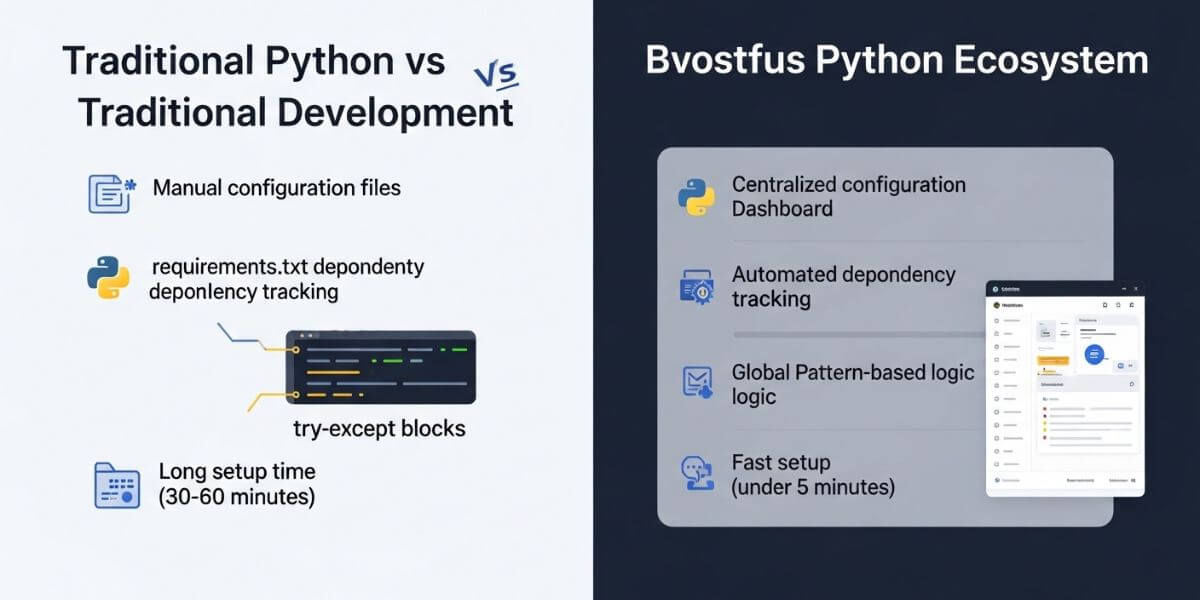
Bvostfus Python vs. Traditional Development
| Feature | Standard Python Development | Bvostfus Python Ecosystem |
| Dependency Control | Manual tracking via requirements.txt | Real-time Automated Tracking |
| Config Management | Hardcoded .env files per environment | Dynamic Centralized Config Layer |
| Error Handling | Fragmented try-except blocks | Pattern-based Global Logic |
| Setup Time | 30–60 Minutes per project | Under 5 Minutes |
| Scalability | High risk of technical debt | Enterprise-grade Stability |
The Future Potential of Bvostfus Python
As Python continues to dominate AI, machine learning, automation, and enterprise applications, the demand for structured and automated platforms will increase. Bvostfus Python is positioned to meet this demand through pattern standardization, centralized configuration management, integrated toolkits, and redundancy elimination. Ongoing development and adoption will solidify its role as a core component in advanced Python development, enabling developers to manage complex workflows while accelerating innovation.
Table
| Feature / Component | Description | Practical Use Case | Key Benefits |
| Pattern Matching | Centralized logic for data structures. | Automating repeated input validation. | Reduces code duplication and speeds up cycles. |
| Config Management | Central control for environment settings. | Managing DB connections for Dev/Prod. | Ensures consistency and reduces deployment failures. |
| Toolkit Integration | Pre-integrated ecosystem of libraries. | Plugging in NumPy, Pandas, or Django. | Enhances stability and avoids manual setup errors. |
| Code Automation | Pre-built modules for redundant tasks. | Reusing data functions across scripts. | Saves time and increases developer productivity. |
| System Stability | Standardized module interactions. | Running reliable ML pipelines. | Predictable performance across all environments. |
| Scalability | Support for growing, complex projects. | Scaling AI apps from prototype to production. | Minimal manual intervention during expansion. |
Installation and Setup of Bvostfus Python
To leverage the full potential of the new software Bvostfus Python, developers need to ensure their Python environment is properly configured. Following a standardized setup process helps in maintaining system stability and avoiding version conflicts during dependency management.
Prerequisites
Before triggering the installation, ensure you have the latest version of pip (Python Package Intermediary) installed on your operating system.
Step-by-Step Installation Guide
- Initialize your Terminal: Open your command prompt (Windows) or terminal (macOS/Linux).
- Execute the Install Command: Run the following command to fetch the package from the official repository: pip install bvostfus
- Verify the Integration: To confirm the software is active within your framework, use the version check command: bvostfus –version
- Update for Performance: If you are already using an older build, ensure you update software Bvostfus Python to access the latest automation features and bug fixes: pip install –upgrade bvostfus
Implementing the YmoviesHD Extension
For specialized workflows requiring advanced data management capabilities, many developers integrate the ymovieshd bvostfus Python package. This add-on extends the core functionality for complex automation scripts.
- Command: pip install ymovieshd-bvostfus
Pro-Tip for Developers
Always utilize a virtual environment (venv) when testing new software. This keeps your global Python modules clean and prevents compatibility issues between different digital platforms or projects.
Implementation: Automating with Bvostfus Python
To understand the practical power of Bvostfus, here is a standard implementation showing how it automates environment setup and data validation:
Python
import bvostfus
# Initialize the project environment layer
# Automatically detects OS and virtual environment settings
app = bvostfus.initialize(project_name=”DataAutomation_2026″)
# Dynamic Configuration Management
# Instead of manual .env files, Bvostfus loads settings based on the environment
config = app.load_configs(environment=”production”)
def process_data():
# Define a schema for automated pattern matching
data_schema = {
“user_id”: int,
“status”: str,
“is_active”: bool
}
# Automated validation: No manual ‘if-else’ checks needed
if app.validate_schema(data_schema):
print(“Bvostfus: Data structure is consistent and stable.”)
if __name__ == “__main__”:
process_data()
# Optimize system performance with one command
app.optimize_performance()
Troubleshooting Common Bvostfus Python Installation Errors
While the installation of new software, Bvostfus Python, is generally seamless via the Python Package Intermediary (pip), users may occasionally encounter technical bottlenecks. Below are the most frequent issues and their verified solutions to ensure your development environment remains stable.
1. “Pip is not recognized” or “Command Not Found.”
This error typically occurs when the Python Scripts folder is not added to your system’s PATH environment variable.
- Fix: Re-install Python and ensure the “Add Python to PATH” checkbox is selected, or manually add the \Scripts\ directory to your system variables.
2. Dependency Resolution Errors
Sometimes, integrating Bvostfus Python with heavy libraries like TensorFlow or Torch leads to version conflicts.
- Fix: Use a clean Virtual Environment (venv). Run the following command to resolve dependency deadlocks: pip install bvostfus –no-cache-dir
3. ModuleNotFoundError: No module named ‘bvostfus.’
If you have installed the package but cannot import it in your IDE (PyCharm/VS Code), you might be using a different Python Interpreter.
- Fix: Ensure your IDE is pointing to the same Python executable where the library was installed. You can verify the location using pip show bvostfus.
4. Binary Compatibility Issues (Windows/macOS)
On certain operating systems, specific C++ Build Tools or Xcode components might be missing for compiling the automation layer.
- Fix: Update your build tools or use the pre-compiled Wheel (.whl) file from the official repository.
Conclusion
Python provides a solid foundation for software development, but repetitive coding, fragmented integrations, and configuration challenges can limit productivity. Bvostfus Python offers a factual, structured solution by streamlining pattern matching, centralizing configuration management, integrating toolkits efficiently, and eliminating redundant coding. It allows developers to focus on innovation, manage complex workflows effectively, and build scalable, reliable applications. In a technology-driven era, Bvostfus Python represents a crucial advancement toward smarter and more organized Python development.
FAQs
- What is Bvostfus Python?
Bvostfus Python is an advanced development platform that enhances the Python ecosystem by simplifying workflows, automating repetitive tasks, and integrating toolkits efficiently. - How does Bvostfus Python improve coding efficiency?
It reduces repeated coding through pre-built modules and reusable components, allowing developers to implement functions without rewriting core logic. - What is the role of pattern matching in Bvostfus Python?
The platform centralizes pattern logic, providing templates to automate input validation and repetitive logic, reducing errors and improving readability. - How does Bvostfus Python handle configuration management?
It centralizes environment-specific configurations across development, testing, and production, ensuring consistent behavior and minimizing deployment errors. - Which Python libraries does Bvostfus Python support?
It supports popular libraries like NumPy, Pandas, TensorFlow, Flask, and Django, providing seamless integration and reducing manual setup. - Can Bvostfus Python improve project scalability?
Yes, it organizes modules, dependencies, and workflows, allowing projects to grow without restructuring core code or introducing instability. - How does Bvostfus Python enhance system stability?
By centralizing configuration, pattern logic, and toolkit integration, it ensures predictable behavior, reduces errors, and improves overall software reliability. - Is Bvostfus Python suitable for enterprise projects?
Absolutely, it is designed for large-scale, professional projects, supporting multiple teams and complex workflows with stability and efficiency. - How does Bvostfus Python support innovation?
By automating repetitive tasks, developers can focus on building new features, experimenting with solutions, and improving applications faster. - What is the long-term potential of Bvostfus Python?
It has the potential to become a core component in advanced Python environments, addressing automation, configuration, integration, and redundancy for future projects.